All ages
History of Palestine
Three thousand years of Palestinian history — from the ancient Canaanite period through Ottoman rule to the present-day conflict. Explores identity, colonialism, displacement, and resistance through the scholarly frameworks of Edward Said, Avi Shlaim, Ilan Pappe, and Rashid Khalidi. A rigorous, source-driven curriculum that centers the Palestinian experience.
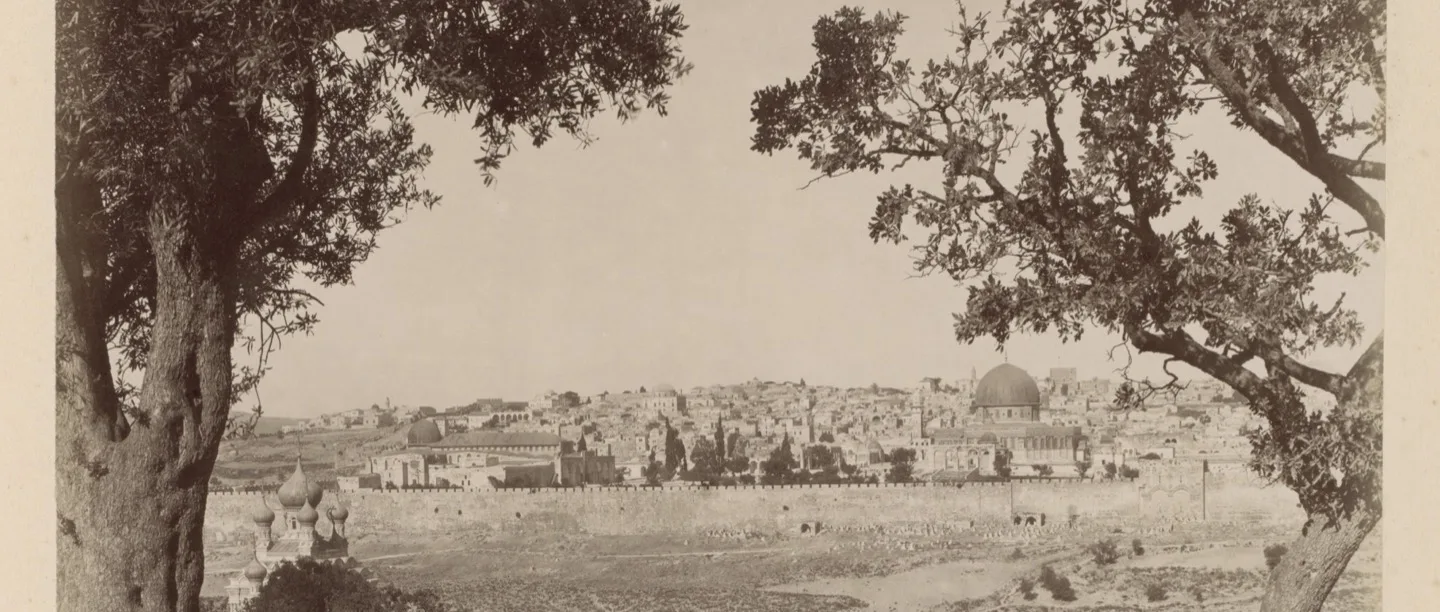
Jerusalem from the Mount of Olives, photographed by Felix Bonfils in the late 19th century.
Félix Bonfils · Public domain
History
- Ancient Palestine to Mamluk Rule (3000 BCE - 1516 CE) Examines Palestine from Bronze Age Canaanite city-states through successive imperial administrations—Israelite kingdoms, Assyrian/Babylonian conquest, Hellenistic period, Roman and Byzantine rule, early Islamic conquest, Crusader kingdoms, and Mamluk governance—emphasizing archaeological evidence, religious transformations, and continuities in material culture and settlement patterns that shaped the region before Ottoman conquest.
- Pre-Modern Palestine: Ottoman Rule to 1800 Examines Palestine under Ottoman administration from conquest through the 18th century, exploring political structures, religious communities, economic life, and cultural traditions that shaped Palestinian society before modern colonial encounters.
- Late Ottoman Palestine and the Rise of Zionism (1800-1917) Explores Palestinian society during the Tanzimat reforms, the emergence of Arab nationalism and early Palestinian identity formation (Khalidi's pre-Mandate analysis), early European settler colonialism, and the foundations of the Zionist movement that would reshape Palestinian life.
- British Mandate and Rising Conflict (1917-1948) Examines Palestinian society under British colonial rule using Khalidi's 'iron cage' framework—structural constraints created by British colonialism AND Palestinian leadership errors—the contradictions of the Mandate system, intensifying Zionist settlement, and Palestinian resistance culminating in the 1936-39 revolt.
- The Nakba and the 1948 War: Ethnic Cleansing Debate Examines the 1948 war and Palestinian catastrophe through the frameworks of Ilan Pappe's ethnic cleansing thesis and Avi Shlaim's archival research, analyzing military operations, mass displacement, and contested historiography.
- Divided Land and Diaspora (1948-1967) Examines Palestinian life fragmented across refugee camps, Israeli military rule, Jordanian and Egyptian administration, diaspora communities, and the reemergence of Palestinian political organizing emphasizing agency (Khalidi's framework).
- Military Occupation and Resistance (1967-1987) Examines the 1967 war, Israel's occupation of the West Bank and Gaza, settlement colonization, Palestinian resistance movements, and the PLO's evolution into government-in-exile with continued emphasis on Palestinian agency and strategic debates.
- Intifadas and the Peace Process (1987-2000) Examines the First Intifada's mass civil resistance, the Oslo peace process and Palestinian Authority's establishment through Khalidi's critique of leadership and structural constraints ('Brokers of Deceit' themes), settlement expansion despite negotiations, and the outbreak of the Second Intifada.
- Contemporary Palestine and Historiography (2000-Present) Examines the Second Intifada, Gaza disengagement and blockade, West Bank separation barrier, failed peace initiatives, BDS movement, and contemporary historiographical debates featuring Khalidi's framework alongside Said, Shlaim, and Pappe.
Ready to start learning?
Start for free