All ages
Islamic Philosophy
Fourteen centuries of Islamic philosophical inquiry — from the House of Wisdom's translation movement to contemporary feminist and decolonial thought. Explores the great debates: Can reason demonstrate God's existence? Does al-Ghazali's Tahafut refute Aristotelian science? What does Avicenna's Flying Man reveal about self-consciousness? Traces rationalist falsafa, Sufi mystical metaphysics, political philosophy, and global dialogue across Arabic, Persian, and Urdu intellectual traditions.
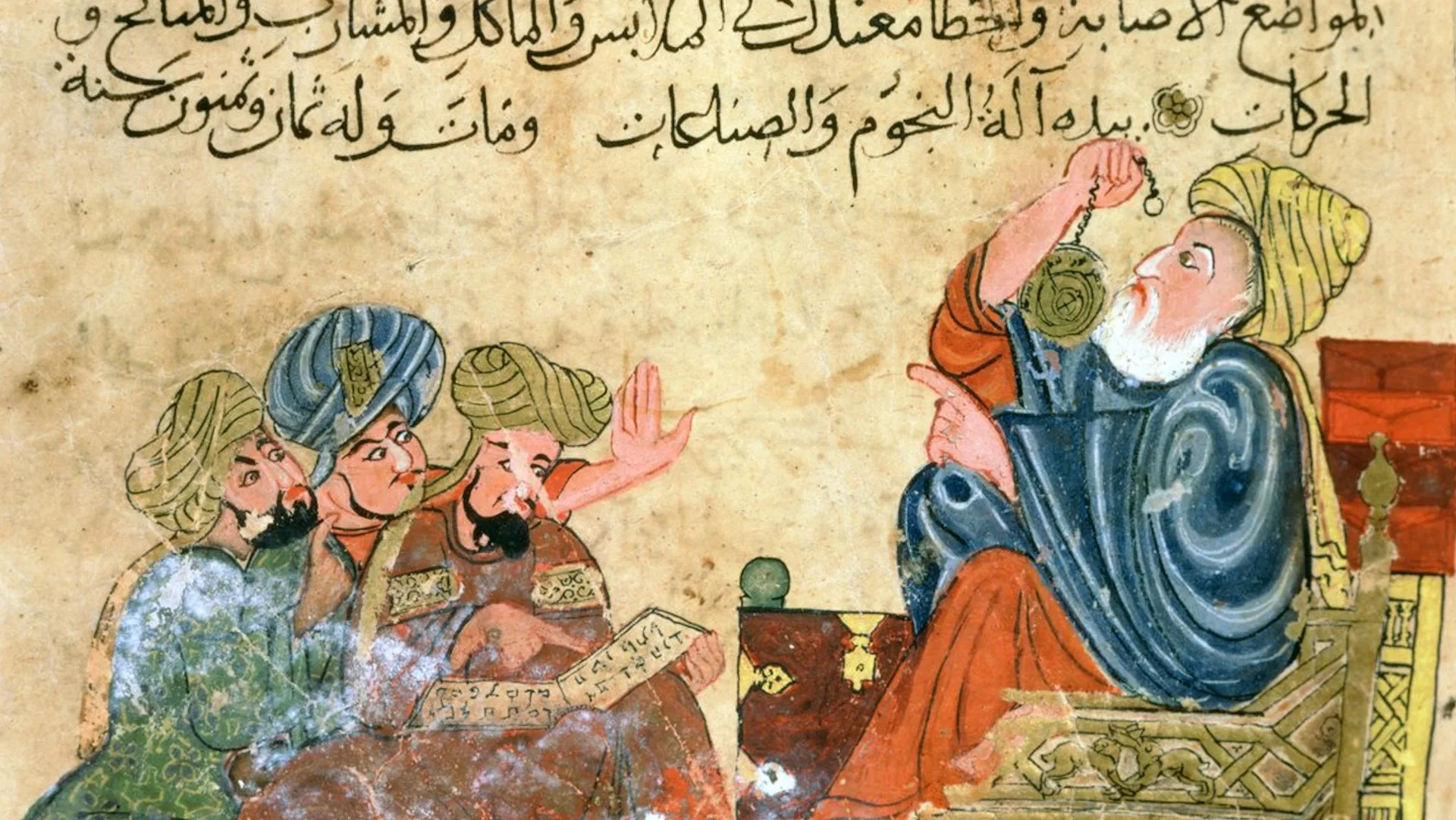
Aristotle teaching, from an Arabic collection of the sayings of Greek philosophers, early 13th century.
Topkapı Palace Library · Public domain
Philosophy
- Islamic Philosophy I Traces the emergence of Islamic philosophy from its pre-Islamic roots through the Abbasid translation movement and the first generation of Muslim philosophers. Covers Kalam theological rationalism, the Arabic reception of Aristotle and Plato, and the pioneering work of al-Kindi and al-Farabi. Explores questions like: What is the relationship between reason and revelation? Can philosophy and Islam be reconciled?
- Islamic Philosophy II A complete study of Ibn Sina (Avicenna, 980-1037 CE), the most influential philosopher in the Islamic tradition. Examines his metaphysics of necessary and contingent being, the Flying Man argument for the soul, his theory of knowledge through the Active Intellect, and his natural philosophy. Explores questions like: What is the difference between existence and essence? How can we know that we exist?
- Islamic Philosophy III Examines the pivotal crisis in Islamic philosophy triggered by al-Ghazali's Incoherence of the Philosophers and Averroes' counter-defense. Covers Andalusian philosophy, the Latin reception of Averroism, and the emergence of Sufi mysticism as philosophical movement. Explores questions like: Did al-Ghazali destroy Islamic philosophy? How did Islamic thought transform European scholasticism?
- Islamic Philosophy IV Explores the rich tradition of Islamic mystical philosophy: Suhrawardi's Illuminationist philosophy of light, Ibn Arabi's doctrine of the Unity of Being, Rumi's philosophical poetry, and Mulla Sadra's Transcendent Wisdom. Examines Sufi ethics and the School of Isfahan. Explores questions like: What is the relationship between light and being? Can love be a form of philosophical knowledge?
- Islamic Philosophy V Examines Islamic theories of governance, justice, and political order from Ibn Khaldun's groundbreaking philosophy of history through Ottoman political thought, modern political Islam, and contemporary debates on human rights and democracy. Explores questions like: What drives the rise and fall of civilizations? Can Islamic political philosophy support democratic governance?
- Islamic Philosophy VI Surveys contemporary Islamic philosophical movements: neo-traditional and perennial philosophy, Islamic feminist thought, interfaith philosophical dialogue, applied ethics in bioethics and AI, and decolonial Islamic epistemology. Recovers neglected voices including West African and South Asian Islamic philosophy. Explores questions like: What does Islamic feminism contribute to global philosophy? How does the tradition address artificial intelligence?
Ready to start learning?
Start for free